What Is BMI and How to Calculate Body Mass Index Correctly?
A Comprehensive Guide to Understanding and Calculating Your Body Mass Index
What Is BMI and How to Calculate Body Mass Index Correctly?
Maintaining a healthy weight is one of the most important aspects of overall wellness. A simple yet powerful tool used by doctors, nutritionists, and fitness experts to assess weight status is the Body Mass Index (BMI). BMI helps determine whether a person’s weight falls within a healthy range based on their height.
Health organizations such as the World Health Organization widely use BMI as a screening tool to identify potential health risks associated with being underweight, overweight, or obese. Although it is not a perfect measurement, BMI provides a quick and reliable way to evaluate weight-related health risks for most adults.
In this comprehensive guide, you will learn what BMI is, how to calculate BMI correctly, understand BMI categories, and discover how maintaining a healthy BMI can support long-term health.
What Is BMI (Body Mass Index)?
Body Mass Index, commonly known as BMI, is a numerical value derived from a person’s weight and height. It helps estimate whether someone has a healthy body weight for their height.
The concept of BMI was first developed by Belgian mathematician Adolphe Quetelet in the 19th century. Originally called the Quetelet Index, it later became widely adopted in medical and health research.
BMI does not directly measure body fat, but it provides a useful approximation that helps identify possible health risks. Medical professionals often use BMI alongside other measurements such as waist circumference, body fat percentage, and overall lifestyle factors.
BMI is commonly used to screen for health conditions such as:
- Heart disease
- Type 2 diabetes
- High blood pressure
- Certain cancers
- Metabolic disorders
According to health experts and organizations like the Centers for Disease Control and Prevention, monitoring BMI regularly can help individuals understand their weight status and make informed health decisions.
BMI Formula: How to Calculate BMI Correctly
Calculating BMI is simple and requires only two measurements: weight and height.
BMI Formula (Metric System)
BMI = frac{weight (kg)}{height^2 (m^2)}
In this formula:
- Weight is measured in kilograms
- Height is measured in meters
- Height is squared before dividing weight by it
This calculation produces a number that represents your BMI.
BMI Formula (Imperial System)
For those using pounds and inches, the formula changes slightly:
BMI = (703 × weight in pounds) ÷ height in inches²
Although the formula may look complicated at first, it only involves simple arithmetic.
Step-by-Step Example of BMI Calculation
Let’s understand BMI calculation with a practical example.
Imagine a person who weighs 70 kilograms and has a height of 1.75 meters.
Step 1: Square the height
1.75 ×
1.75 = 3.06
Step 2: Divide the weight by the squared height
70 ÷
3.06 = 22.9
The calculated BMI is 22.9.
This BMI value falls within the healthy weight range, which indicates a balanced relationship between weight and height.
Understanding how to calculate BMI manually helps verify results when using online BMI calculators.
BMI Categories and Healthy Weight Range
BMI results are grouped into categories that help determine weight status. These categories help healthcare professionals assess potential health risks.
If your BMI is below 18.5, it is considered underweight. This may indicate insufficient nutrition, underlying health issues, or increased risk of weakened immunity.
A BMI between 18.5 and 24.9 is considered the normal or healthy range. Individuals within this range generally have the lowest risk of weight-related health conditions.
When BMI falls between 25 and 29.9, it is categorized as overweight. At this stage, individuals may begin experiencing increased risk for metabolic conditions such as diabetes or high blood pressure.
A BMI of 30 or higher falls into the obesity category. Obesity significantly increases the risk of heart disease, stroke, joint problems, sleep apnea, and other chronic health conditions.
Understanding where your BMI falls can help guide lifestyle decisions and encourage healthier habits.
Why BMI Is Important for Health
BMI has remained one of the most widely used health indicators because it offers several advantages.
First, it is quick and easy to calculate. Anyone can determine their BMI within seconds using only height and weight measurements.
Second, BMI is cost-effective. It does not require expensive medical equipment or laboratory tests, making it accessible to people worldwide.
Third, BMI helps identify early health risks. High BMI levels are often associated with increased risk of chronic diseases.
Research shows that individuals with elevated BMI levels may face higher risks of conditions such as:
- Cardiovascular disease
- Insulin resistance
- Fatty liver disease
- Joint problems
- Sleep disorders
Public health organizations, including the National Institutes of Health, use BMI data to monitor obesity trends and develop health policies aimed at improving population health.
Limitations of BMI
Although BMI is a useful screening tool, it is important to understand its limitations.
One of the main limitations is that BMI does not directly measure body fat. Instead, it estimates weight relative to height. This means it cannot distinguish between fat mass and muscle mass.
For example, athletes and bodybuilders may have a high BMI because muscle weighs more than fat, even though their body fat percentage is low.
Another limitation is that BMI does not consider fat distribution. Fat stored around the abdomen can pose greater health risks compared to fat stored in other parts of the body.
BMI may also be less accurate for certain groups such as pregnant women, older adults, and highly trained athletes.
Because of these limitations, healthcare professionals often combine BMI with additional assessments such as waist circumference, lifestyle evaluation, and medical history.
BMI vs Body Fat Percentage
Many people confuse BMI with body fat percentage, but the two measurements serve different purposes.
BMI measures weight relative to height and provides a general health screening tool. It is simple to calculate and useful for large population studies.
Body fat percentage, on the other hand, measures the actual proportion of fat in the body. It provides a more precise understanding of body composition.
Measuring body fat percentage usually requires specialized tools such as bioelectrical impedance devices, skinfold calipers, or advanced medical scans.
Although body fat percentage provides more detailed information, BMI remains widely used because it is simple, fast, and accessible to everyone.
Tips to Maintain a Healthy BMI
Maintaining a healthy BMI requires consistent lifestyle habits that support overall health.
One of the most important factors is following a balanced diet. Eating nutrient-rich foods such as fruits, vegetables, whole grains, lean proteins, and healthy fats helps maintain proper energy balance.
Regular physical activity is equally important. Experts recommend at least 150 minutes of moderate exercise per week. Activities like walking, cycling, swimming, and strength training can help maintain a healthy weight.
Proper hydration also supports metabolism and helps regulate appetite. Drinking enough water throughout the day is a simple yet effective habit for weight management.
Getting adequate sleep is another important factor. Poor sleep can disrupt hormones that control hunger and metabolism, increasing the risk of weight gain.
Finally, monitoring your weight and BMI regularly allows you to track progress and make adjustments to your lifestyle when necessary.
When Should You Consult a Doctor?
BMI can provide helpful guidance, but it should not replace professional medical advice.
You should consider consulting a healthcare professional if your BMI falls outside the healthy range or if you experience sudden changes in weight.
Medical guidance may be particularly important if you have existing health conditions such as diabetes, heart disease, or thyroid disorders.
Doctors can provide personalized advice on nutrition, physical activity, and weight management strategies tailored to your specific needs.
Frequently Asked Questions (FAQs)
1.
What is BMI?
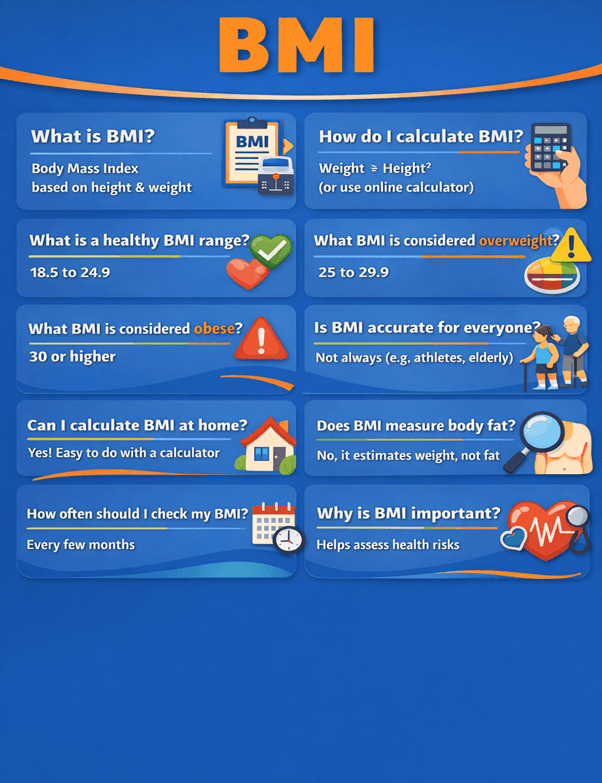
BMI (Body Mass Index) is a measurement that uses a person’s height and weight to estimate whether they are underweight, at a healthy weight, overweight, or obese.
It is commonly used as a screening tool to identify potential health risks related to body weight.
2.
How do I calculate BMI?
You can calculate BMI by dividing your weight in kilograms by the square of your height in meters.
Many people also use online BMI calculators to get instant results without manual calculations.
3.
What is a healthy BMI range?
A healthy BMI for most adults falls between 18.5 and 24.9.
This range is generally associated with the lowest risk of weight-related health problems.
4.
What BMI is considered overweight?
A BMI between 25 and 29.9 is considered overweight.
People in this range may have a higher risk of developing health issues such as heart disease or diabetes.
5.
What BMI is considered obese?
A BMI of 30 or higher is classified as obesity.
Obesity increases the risk of several serious health conditions, including cardiovascular disease, high blood pressure, and type 2 diabetes.
6.
Is BMI accurate for everyone?
BMI is useful for most adults, but it may not always be accurate for athletes, pregnant women, elderly individuals, or people with high muscle mass.
In these cases, additional health measurements may be required.
7.
Can I calculate BMI at home?
Yes, you can easily calculate BMI at home using your height and weight.
Many free online BMI calculators also provide instant results and health interpretations.
8.
Does BMI measure body fat?
No, BMI does not directly measure body fat. It only estimates weight relative to height.
Other methods such as body fat percentage measurements provide more accurate information about body composition.
9.
How often should I check my BMI?
Checking your BMI every few months is usually enough to monitor changes in weight and maintain healthy lifestyle habits.
10.
Why is BMI important for health?
BMI helps identify potential health risks related to body weight.
Maintaining a healthy BMI can lower the chances of developing chronic diseases such as heart disease, diabetes, and hypertension.
Final Thoughts
Body Mass Index (BMI) remains one of the simplest and most widely used tools for assessing weight status and potential health risks. By comparing weight to height, BMI provides a quick snapshot of whether your body weight falls within a healthy range.
However, BMI should always be considered alongside other factors such as lifestyle, diet, physical activity, and medical history. A healthy lifestyle built on balanced nutrition, regular exercise, and good sleep habits plays a crucial role in maintaining overall well-being.
Understanding how BMI works empowers individuals to take control of their health and make informed decisions that support long-term wellness.
Regularly monitoring BMI and maintaining healthy habits can significantly improve quality of life and reduce the risk of chronic diseases in the future.
If you want a quick and hassle-free way to check your BMI, try the free BMI calculator available on SnapToolsOnline. Our easy-to-use tool helps you instantly calculate your BMI and understand your healthy weight range in seconds. Whether you're tracking your fitness progress or simply curious about your health, SnapToolsOnline provides reliable tools to support your wellness journey.